Wednesday, August 8, 2012

SEPHARDIC RABBIS: Yehuda Alqalai (1798-1878)


Rabbi Yehuda Chai Alqalai (or Alkalai) was born in Sarajevo, Bosnia. He came to Israel with his parents at the age of 11.  At a very young age he was ordained as a rabbi by Rabbi Eliezer Pappo, the author of Pele Yo'etz.  He was sent from Israel to serve as the Rabbi of the important Sephardic community of Zemun (present day Serbia).

In 1839 rabbi Alqalai met with rabbi Yehuda Bibas (see this), who inspired him and shared with him his enthusiastic ideas about the return of the Jews to the land of Israel.

In 1840 the Jewish world was  shocked by the Damascus blood libel. Not only because of the ridicule accusations that "Jews killed gentiles to consume their blood", but especially because the French authorities in Damascus and the modern "media" of that time, accepted those absurd accusations. "The Jews thought that the world had outgrown, especially in the West, where Jews were convinced that Western culture would not accommodate such terrible lies."

The Damascus libel affair represented a turning point in the life of Rabbi Alqalai. His ideals would now become part of a practical plan to restore the Jews to the land of Israel and obtain their political independence, as Rabbi Yehuda Bibas had envisioned and preached. 

Rabbi Alqalai published in 1840 his first book, Minchat Yehuda, where he called the Jews to reunite in the land of Israel. 
  
Rabbi Alqalai had practical plans for the establishment of the Jews in israel. He wrote and spoke about the need of teaching the Hebrew language to the Jews. He saw that the revival of Hebrew will represent a unifying factor between the Jewish communities worldwide. He also wrote about the need of having a Jewish Bank which, through individuals' funds, will buy lands in Israel. He insisted in the urgency to address the Sultan of the Ottoman Empire. He suggested the formation of joint-stock company between the Jewish Bank and the Ottoman Empire, such as a steamship or railroad trust, with the purpose of inducing the  Sultan to cede Palestine to the Jews as a tributary country, on a plan similar to that on which the Danube Principalities were governed.


To be continued....


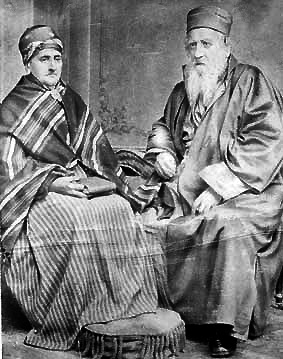
Rabbi Yehuda Alqalai with his wife Esther (Viena, 1874).


Read here about the Damascus Blood Libel of 1840


Tuesday, August 7, 2012

RELIGIOUS INTEGRITY: When all depends on the intention

We have explained the prohibition of genebat da'at, i.e., when I falsely pretend that I care or I want to help, just to benefit from leaving a positive impression in somebody else mind. Our Rabbis classified these actions as "stealing peoples' mind". 

A typical example: If one of my friends is preparing a party or an event for which manpower is required, and my help is definitely needed.  And, for whatever the reason might be, I don't come to help. But when I estimate that everything is done and ready and my help is not needed anymore, I come to my friend's house to offer my help.  And when my friend tells me that everything is already done, I pretend as if I'm sorry and regret that I can not be of help...   For me, it might look like a win/win situation: I have not helped, and I still enjoy the benefit of having left a positive impression on my friend as if I had really helped him! 

The Tora condemns this type of cynical attitude and considers it a form of  "stealing". 

There are some cases, however, in which one can sincerely be offering his or her help, even though one knows that his offer will be refused. If for example, I come to my friend's house and I see that he has an unexpected guest or event, etc. and then I sincerely offer my help, not to cause a false impression, but to show that I care, knowing that my empathy will make my friend feeling good, then it is absolutely valid.  

In other words, the issue of genebat da'at depends on one's intention and cannot be judged by a third party based just on the facts at sight. genebat da'at pertains to a category of actions that are judged only between oneself and God.  


ZERO POINT THREE PERCENT, 
a film about Jewish unity. 


Monday, August 6, 2012

JEWISH WEDDING: Fasting on the wedding day


In many Jewish communities it is customary for the groom to fast the day before the wedding. This is because according to the Talmud Yerushalmi (Bikkurim 3:3), on the day that a person is married, all of his or her sins are forgiven. The fast is a sign of repentance and atonement. "With marriage one is beginning a new phase in life. Marriage involves a complete change in lifestyle, and the person is given a chance to start it with a pure soul. The love that the couple has for one another on their wedding day can annul any misplaced passion that they had in the past". The couple also fast for the future, to deserve "divine guidance that they may be able to overcome problems as they arise" (Rabbi Aryeh Kaplan, Made in Heaven, page 83). In Ashkenazi communities this fast is very important.

 In most Sephardic communities, however, the custom is not to fast. Rabbi Obadya Yosef is very clear about this point and recommends the Sephardic grooms to avoid fasting. Other  Sephardic rabbis like Rabbi Chayim haLevy are even stricter and they forbid the groom to fast. The reason is that they consider that the couple has to be strong to endure all the pressure of the wedding, the party, etc. The process of Teshuba, they reason, can still be achieved by devoting themselves in this important day of their life to study Tora and elevate prayers to God. Rabbi Yosef also recommends that if the groom and bride still desire to fast, they should consider to do a "a fast of words" (ta'anit dibbur) not of food, which represents an even higher sign of self control, repentance and contrition.

In many communities, Ashkenazi and Sephardic, it is customary that the bride and the groom recite the Viduy (prayer of regret and confession, see here) from the Mincha service of Yom Kippur or other similar texts.


The marriage crisis and why singles today don't want to commit, 

by Rabbi Benjamin Blech